
SALES
Sales refers to the activities involved in selling goods and services, which includes understanding customer needs, effectively communicating value and building relationships to foster trust and loyalty. It is fundamentally the exchange of value for currency, where salespeople play a crucial role in attracting prospective buyers and guiding them through the buying process. Sales are essential for generating revenue and acquiring customers, making it pivotal function in any business.
Marketing and sales are two essential functions in a business that work together to drive revenue.
SALES FUNNEL
A sales funnel is the visual representation of the journey a prospect takes from awareness of a product or service to the final purchase. It helps sellers track each prospects progress, allowing them address needs and remove blockers to facilitate a smoother buying process. The funnel typically includes various stages such as Awareness, Interest, Consideration and decision illustrating the customer journey and interactions throughout the sales process, this methodology is essential for maximizing sales productivity and understanding customer behavior.
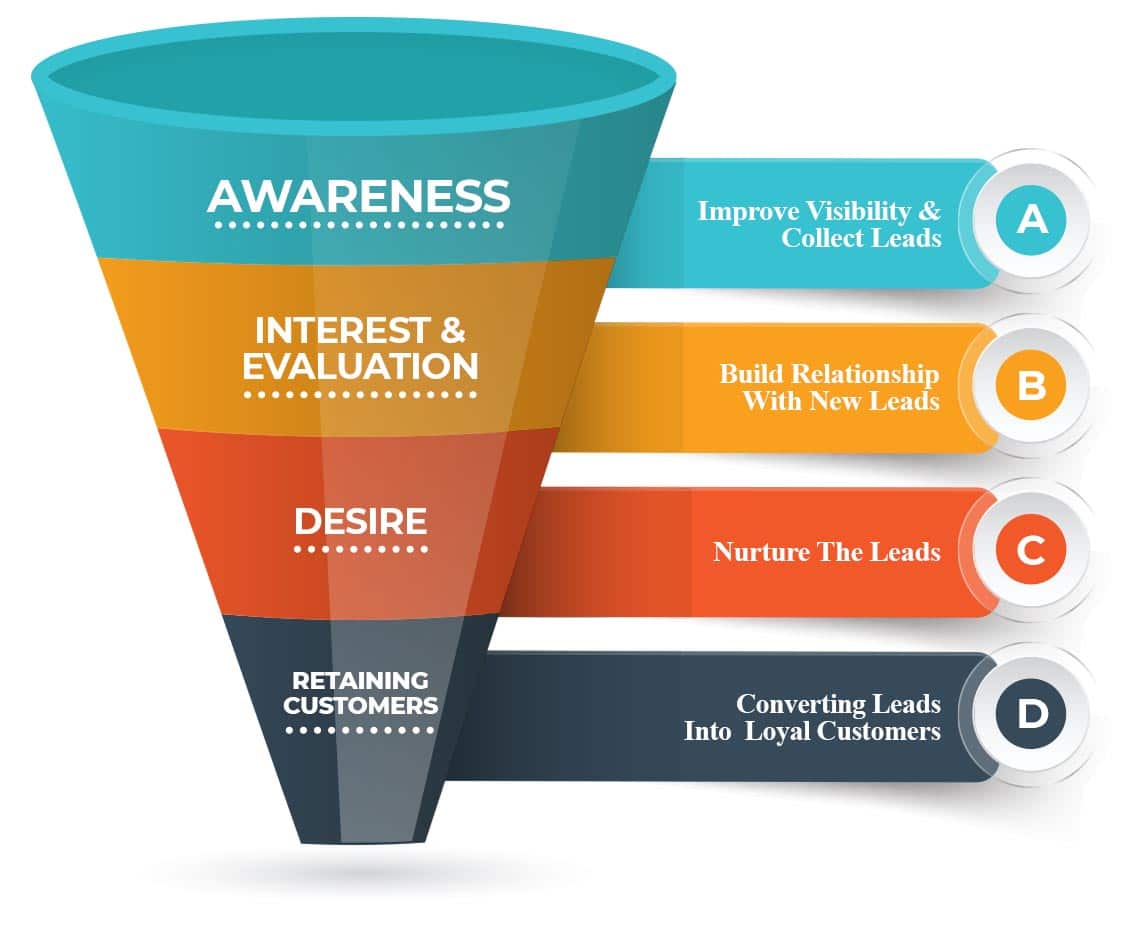
Picture by https://www.reddashmedia.us/
A sales funnel is a marketing strategy designed to turn cold prospects into long-term customers by funneling them through five stages. The “funnel” metaphor means you’ll begin with a large audience of prospective buyers that will eventually pare down to a smaller group of highly targeted, high-value customers.
“The final goal is not to make a sale, at least not a single sale. Instead, the goal is to create returning customers with life-time value.”
Breaking the buyer’s journey down into smaller steps (i.e., stages) allows you to be more precise about how and when you present offers. For a small business owner, you may start with only one or two products. For a large B2B company, you may have numerous offers fueling lead generation and nurturing new leads through the sales cycle, sales pipeline, or sales team.
Suddenly, everything can feel complex. For the sake of simplicity…
Think about ordering at a McDonald’s. If you order a hamburger, you’re asked if you’d like to add cheese. Order chicken nuggets and you’re asked if you want fries with that. Order a combo meal and you’re given the chance to make it a large or “supersize.” This is a sales funnel.
Then, think about McDonald’s new mobile app and its product-specific loyalty programs, like McCafe Rewards:
Every offer is actually a series of offers designed to increase purchase size as well as drive subsequent purchases.
A sales funnel is usually divided into three parts:
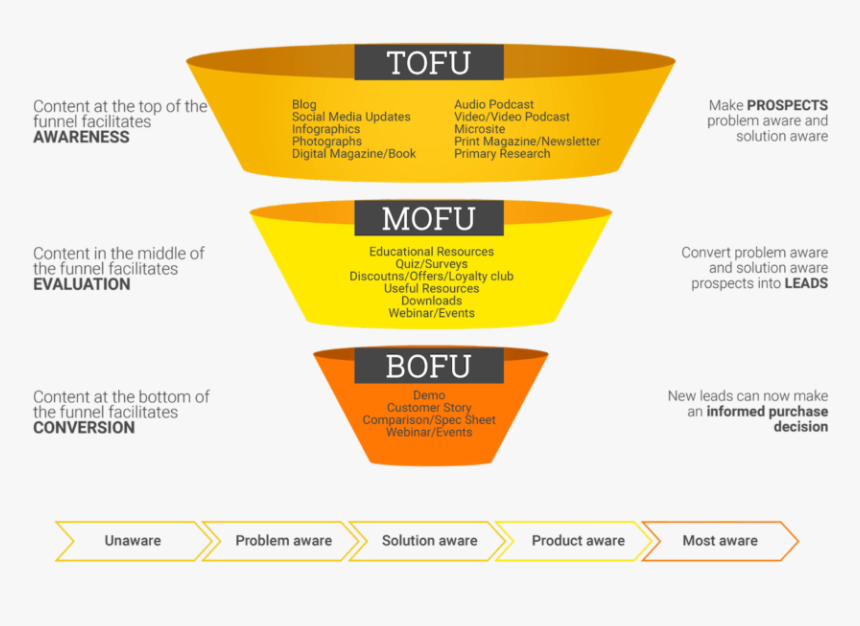
The key to an effective sales funnel: Engage with and provide increasing value to your prospects throughout each sales funnel stage.
No matter how simple or complex, the fact is sales funnels work when they’re built according to certain universal principles. Case in point:
In addition to top, middle, and bottom, sales funnels have traditionally been structured around four sales funnel stages known by the acronym…
The AIDA model was developed in the late 19th century by advertising and sales pioneer Elias St. Elmo Lewis. And, it has become the backbone of almost every successful advertising and marketing campaign since.
Why is it so successful?
AIDA takes potential customers through the emotional journey of making a purchase – guiding the buying decision from initial attraction to taking action.
Sometimes referred to as “attention,” the first stage of the sales funnel is where a brand catches the eye of new audience members via marketing content and/or a valuable baseline offer.
Here, the brand will begin to forge a deeper relationship with their prospects, becoming more actively involved in learning about their goals and/or problems. In doing so, you can begin providing preliminary solutions, allowing them to experience “quick wins” – and become more engaged.
Consumers who reach this third sales funnel stage have become convinced that they do, in fact, have a larger problem that needs solving. Moreover, they’re coming around to the idea of making a purchase to solve said problem. At this point, the brand showcases how their premium offering can be of service.
The final stage of the sales funnel has prospects deciding to purchase (or not purchase) the brand’s premium product or service. You’ll need to reinforce the value of your offer – as well as the downsides of not making a purchase.
These sales funnel stages describe the general process all of us go through – as well as some general action steps you should take to keep their prospects moving further in the funnel.
Depending on what you’re selling and who your target audience is, you’ll want to tailor each stage of your sales funnel(s) accordingly.
(Yes, you absolutely can have more than one funnel in place at a given time. This will become clearer in a bit.)
7 WAYS TO MAKE SALES
CATEGORIES/TYPES OF SALESPEOPLE
1. Relationship Builder: This kind of a salesperson believe relationships in business are more important than anything else.
2. Hard worker: This salesperson is always out there going after leads, working really hard and pushing deals.
3. Problem solver: They are always available to solve customers’ problems,
4. The Lone Wolf: This guy works alone and works by himself without the teamwork spirit.
5. Challenger: This is the person that challenges customers politely and nudges them differently and teach them something new.
PLEASE NOTE
Sales is transactional, it’s the backbone of revenue generation and without it then operating a business or organization will be hard, however salespeople must proceed to be commercial professionals who understand that the sales don’t amount to pure profits and thus apply a balance on the P& L matrix.
The skills required to succeed in the fields of sales and marketing have seen a dramatic shift over the past seven years. The top 10 in-demand skills for market Changed by 50% while sales saw a 60% change.
This demand for new skills was met with a move toward better skill-building opportunities during the Great Reshuffle. In 2021, LinkedIn saw a 31% growth in year-over-year career change among members in marketing. More than half of those leaving their jobs changed careers entirely.
The key to creating and retaining strong sales and marketing teams is to ensure you are investing in their skill development.
The skill sets that make sales and marketing teams successful are a combination of both hard skills (what a person knows) and soft skills (how a person thinks and behaves).
In sales and marketing, some of the most in-demand hard skills include:
Soft skills are non-technical abilities, such as communication, teamwork, and problem-solving. These are often referred to as “people skills” or “interpersonal skills.” These skills are vital to the human side of sales and marketing.
Soft skills typically transcend job categories, though in sales and marketing, some key skills to have include:
While there is some urgency around the upskilling and reskilling of hard skills to meet the demands of an ever-evolving technology landscape, ignoring the development of soft skills can leave your team with a serious deficit.
Soft skills are the kinds of skills that follow you throughout your career. Data platforms come and go, but the ability to communicate clearly will serve you no matter what role you’re in. It’s important to invest in the development of both sets of skills as your sales and marketing team grows.
Not a member yet? Register now
Are you a member? Login now