UNIT 2: GOVERNANCE LESSON CONTENTS
3.1 Participatory
3.2 Rule of Law
3.3 Consensus Oriented
3.4 Equitable and Inclusiveness
3.5 Effectiveness and Efficiency
3.6 Accountability
3.7 Transparent
3.8 Responsive
What is Governance?
1.Introduction
This module forms the second part of the Public Policy and Governance Course. It focuses on the issue of governance that has taken a greater significance as more countries are being democratized and new areas of what governance should look like are emerging.

The unit discusses the concepts of good governance and ethics and examines the role of ethical behavior and standards in government. The most important aspect of this unit is to study how idea of good governance can be applied to public sector administration. This is important because unlike most organizations, the public sector’s goal is to enhance and improve the wellbeing of citizens through the effective implementation of public policies.
The idea of governance is said to be as old as the first communities and since the beginning of the millennium there has been an increased interest in the term. Although the idea was initially on public sector management, Simonis (2004) notes that there was a gradual shift of focus in the late 1980s and early 1990s at the end of the cold war.

The change began when international organizations such as the World Bank began to use it as a condition for extending credit to developing countries. Gisselquist (2012:2) states that in 1989, the World Bank ‘declared that ‘a crisis of governance’ underlay ‘the litany of Africa’s development problems.’ This began a period where the international organisations realised that market-based policies with the market as the driver of growth and development were failing while aid resources were not being managed properly.
The focus was now on to find out the reason for the failure and this was placed squarely on the shoulders of poor governance and this began the call for the need for good governance (Gisselquist: 2012)
Because of this reason of poor governance that had seen many countries continue to grapple with lack of development and developmental issues such as poverty, poor health and education services, international bodies such as the United Nations and World Bank began to focus on ‘good’ governance to ensure that these global issues are properly tackled.

Like many concepts, defining governance within a restricted corridor remains contentious with a wide range of definitions trying to provide some understanding of the concept. Some of the definitions such as the initial World Bank definition are broad covering issues such as rules, enforcement mechanisms, and organizations.
The World Bank has further expanded this definition and states that; “Governance is the manner in which power is exercised in the management of a country’s economic and social resources for development” . This has been additionally redefined to include more criteria and give it a more normative perspective. One of the new definitions is that governance is; “…the traditions and institutions by which authority in a country is exercised. This includes the process by which governments are selected, monitored and replaced; the capacity of the government to effectively formulate and implement sound policies; and the respect of citizens and the state for the institutions that govern economic and social interactions among them.8 ”
The normative aspect of the term is still being contested because, some argue that, for example, the exercise of power can be found in different kinds of governments and even though there has been emphasis on democracy as the ideal form of government and in essence governance that can provide development9 , Fukuyama (2013) argues that governance should be seen as ‘a government’s ability to make and enforce rules, and to deliver services, regardless of whether that government is democratic or not ’.
He argues that ‘good’ and ‘bad’ governance can be found in all types of government even though recent trends have been to link ‘good’ governance to democracy. He goes on to state that the idea of governance has taken a more normative slant, with criteria being developed to explain what is required for effective governance.
However, Fukuyama argues that contrary to that push for a more normative perspective for understanding the idea of governance, ‘the quality of governance is different from the ends that governance is meant to fulfil’ and that governance was ‘about the performance of agents in carrying out the wishes of principals, and not about the goals that principals set.’ He saw government as an organization and governance was about the execution of its goals by its agents irrespective of whether the goals were good or bad as opposed to normative slant currently being attached to it.

The fact that some criteria have been developed to define what good governance should resemble comes with its own problems. The criteria include accountability, transparency, anti-corruption, rule of law, advancement for women, democracy and decentralization. But Botchway (2001) notes that, defining these criteria makes it difficult because they are value-laden, making it hard to find an acceptable form of good governance.
The previous section has attempted to define the idea of governance and how this has evolved into the current idea of good governance. When the international institutions began to focus on good governance as a criterion for the provision of aid and other kinds of assistance to developing countries, there was a need to create a framework that can be used as a platform for what constitute good governance.

A number of characteristics were identified for what entails good governance where it was said to be one that was ‘participatory, consensus-oriented, accountable, transparent, responsive, effective and efficient, equitable and inclusive and follows the rule of law. Aside from these, it was also assured that corruption was minimized in these countries and the voices of fringe groups were heard during the process of decision making (Gisselquist, R.M 2012). This is depicted in the figure below;
Figure I
Principles of Good Governance by the United Nations
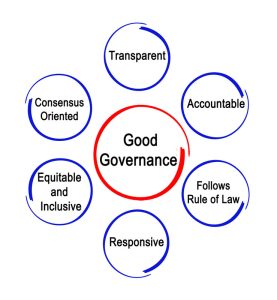
Most analysts have generally agreed on these characteristics as representative of what good governance should look like and we will examine the components of each of these characteristics.
3.1 Participatory

The participatory aspect of good governance is that every citizen that meets the criteria must have a voice in the decision-making process ‘either directly or through – 40 – legitimate intermediate institutions that represent their interests.’ This is based on the foundation built on freedom of association and speech, as well as capacities to participate constructively.
3.2 Rule of law
Under this, it is expected that all laws and their implementation should be ‘fair and enforced impartially, particularly the laws on human rights. This to ensure that everyone can trust the law to uphold their rights, rather than a situation where only the powerful can be assured of their rights being guaranteed.
3.3 Consensus Oriented

The idea behind a Consensus oriented decision-making process is to ensure that all citizens are guaranteed a common minimum when they are unable to get what they want to the fullest. It focuses on reaching a consensus in a community where there are many competing interests that cannot all be satisfied.
3.4 Equitable and Inclusiveness:
Good governance is meant to ensure an equitable society with citizens having equal opportunities to improve or maintain their well-being.

3.5 Effectiveness and Efficiency
It is expected that good governance will allow for the maximum use of resources that results in optimal outcome that meet the needs and address the concerns of the community.
3.6 Accountability
It is stated that because governments are accountable to the people, good governance means that governments must be accountable to the citizens they serve. There is a call for greater accountable of government institutions to the public.
3.7 Transparency
Information flow should be free and easily accessible to the public so that they can monitor and, in some cases, make the institutions more accountable. There should also be a free media.
3.8 Responsive
The United Nation’s framework also states that ‘good governance requires that institutions and processes try to serve all stakeholders within a reasonable timeframe’11. This is important because it builds trust between the stakeholders and government which is important in how the citizens see government.

4.0 Frameworks of Good Governance
These eight characteristics form the basis of good governance, and it is against these that many international institutions have tried to expand the concept further. We will examine a number of these concepts as they provide better understanding of what good governance should look like.
4.1 The UNECA Concept
The United Nations commissioned a project to monitor African states as they try to provide good governance. The project consisted of 28 countries in the five sub-regions of Africa. To measure how far these countries had gone in improving governance, six components were identified as the basis for measuring their success. These were;

4.2 The ADB Concept
The second approach was developed by the Asian Development Bank (ADB)in 2001-2002. The ADB’s Poverty Task Force produced a proposal intended to serve as an input for the implementation of the Comprehensive Poverty Reduction and Growth Strategy of the Government of Vietnam.
The task force identified five key areas of governance where improvement was required. These were

From these five parameters, the task force developed eight core indicators, which are that government must
The Poverty Task Force then proceeds to propose, for each of the preceding core indicators, a number of outcome and process indicators.
4.3 The APRM Concept
The African Peer Review Mechanism (APRM) is a mutually agreed instrument voluntarily acceded to by the 54-member States of the African Union. The instrument is meant to be a self-monitoring mechanism intended to foster the adoption of policies, standards and practices that will lead to political stability, sustainable development and regional and continental integration through sharing of experiences and of successful best practices, including identifying deficiencies and assessing the needs for capacity building.

The main principles of the APRM processes are the following: national ownership and leadership, transparency and broad-based participation. The APRM developed a questionnaire for each of its four core areas. This had clear objectives, standards and codes, criteria and indicators that assessed the programmes and policies of the participating countries.
The questionnaire can be summarized as follows:
4.3.1 Political Governance
Under this core area are six clear objectives that are as shown below;

4.3.2 Economic Governance
Under this core area there are 4 objectives and these are;
4.3.3 Corporate Governance
Under the corporate governance core area, we have 5 objectives, namely;

4.3.4 Socio-Economic Development
The socio-economic development aspect of the mechanism has 6 objectives and these are;

finally;
These frameworks discussed have similar characteristics with the focus on anti-corruption, an independent judiciary, an enabling environment for businesses, a free press, a democracy that allows for representation, the fight against poverty and improved girl-child education. These have become the foundation for countries as they develop their public policies making sure these are observed as they develop their public policies.
Appendix I provides other frameworks that provide the characteristics of good governance as developed by other regional and global institutions.
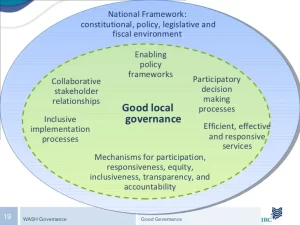
The previous sections have discussed the concept of governance and the key features that are required for good governance. Figure II provides a graphic illustration of the relationship between good governance and public policy. This provides a working framework of how we can understand the interlink between the two. This section examines how this work together and why it is important. The first aspect is the need for a strong commitment to integrity, ethical values and the rule of law and we shall examine these individually.
Figure II Relationships between the Principles of Good Governance in the Public Sector.
5.1 High Integrity
The argument is that because the public sector has the responsibility for the management of a large proportion of a country’s resources through taxation and other sources, in the provision of social services to the citizenry, they are expected to adhere to a high level of integrity and be accountable for their actions. They are also expected to abide by existing legislations and government policies in the completion of their duties.

Due to this, the public sector is expected to ‘encourage and enforce a strong commitment to ethical values and legal compliance at all levels’ . When we discuss high integrity, we refer to a situation where the foundation of governance (or the government) is the promotion of a culture where serving the public interest is the norm. There should be processes that clearly state what is expected by public officers in the execution of their duties. These include codes of conduct and clear performance assessment and reward processes.
5.3 Openness and Comprehensive Stakeholder Engagement
We know that public sector institutions are established and are run to improve public welfare and because of this, there is a need for openness about their activities. Their activities are expected to have ‘clear, trusted channels of communication and consultation’ so that all stakeholders can engage with them effectively.
5.4 Defining outcomes in terms of sustainable economic, social, and environmental benefits.
The concept requires that the goals and plans of the public sector must be sustainable so as to ensure continuity in the institutions responsible for implementing the public policies. Stakeholder inputs, which could be different, is important to ensure that the competing needs and concerns are balanced given the limited resources available to implement the policies.
5.5 Determining the interventions necessary to optimize the achievement of intended outcomes.
In order to achieve its goals, the. public sector must get the right mix of legal, regulatory, and practical intermediations. This is important to ensure that the goals of the policies are achieved.

5.6 Developing the capacity of the entity, including the capability of its leadership and the individuals within it.
The Public sector must ensure that it has the right structures, leadership and the people with the rights skills and mindsets to execute its policies. Because of changes in personnel of the entity and the environment in which the entity operates, there will be a continuous need to keep developing its capacity as well as the skills and experience of its leadership and individual staff members.
5.7 Managing risks and performance through robust internal control and strong public financial management.
It has also been suggested that the entities mandated with executing public policies should have effective performance management systems in place so that they can effectively and efficiently deliver the services required. There must be risk management and internal control processes in place to ensure that they deliver on the goals. The institutions should also have strong financial management systems in place that enforce financial discipline, strategic allocation of resources, efficient service delivery, and accountability.
5.8 Implementing good practices in transparency and reporting to deliver effective accountability.
The idea of accountability is a cornerstone of good governance and forms the foundation for the policy making process. Accountability is supposed to be effective so that stakeholders understand and can respond to any issues that arise while the activities are being implemented.
6.0 Conclusion
This unit has examined what we understand by governance and how since the late 1980s onwards there has been a push for good governance. This was based on the premise that the inability of governments to provide the services for their citizens has been due to poor or bad governance. The foundations of good governance have been incorporated into public policy processes especially in developing countries where it has become a requirement for accessing aid and international funding. The next module will examine the policy making process, from identification to development, implementation and evaluation.

Not a member yet? Register now
Are you a member? Login now