

Communication is the process of passing information (sending) and understanding (receiving) the same from one person to another through verbal and non-verbal means. Thus, communication means to understand information, facts or opinions of someone.
Communication is the giving and receiving of feedback between individuals and/or groups for the purpose of exchanging information.
The word communication originates from the Latin word “communis” which means “Common”. This means that we try to establish “commonness” with someone in communication.

Literally, communication means to inform, to tell, to show, or to spread information. Thus, it may be interpreted as an interchange of thought or information to bring about understanding and confidence for good industrial relations.
The word “Communication” has been defined differently by different management thinkers and experts. Some of these definitions of communication are given below:


According to Koontz and Weihrich, communication is needed to:

Communication could have many purposes depending on the context and person involved. Communication within a family, seminar, theatre, office has different purposes that have to be achieved.
Purposes of Communication are:

The basic purpose of Communication is to keep the people informed. Various important facts and information are required to be given on time.
Peter F. Drucker has stated,” “The manager has a specific tool: Information ……….”.
Thus, communication may be to inform the people about ideas, views, suggestion etc. Managers need complete, accurate and precise information to plan and organize. Employees need it to translate planning into reality.

Persuasion may be defined as an effort to influence the attitudes, feelings or beliefs of others. Persuasion consists of four important steps:

All these depend on effective communication. It is not enough to inform the people, along with it they need persuasion to attain common goals. Thus, communication is to pursue people so that they ensure their efforts in right direction.
Communication may have a purpose to educate the people. It is very conscious process of communication. It involves both teaching and learning with an object to widen knowledge as well as improve skills.
For the purpose knowledge, skills and attitude are developed among the people by communication.

Training is the act of increasing the knowledge and skill for a particular task, communication is an integral part of training. To achieve proficiency in a particular field instructions, lectures, demonstrations, practices and discussion are required which are part of communication.
Motivation is creating and releasing work energy within an individual. High level of morale and motivation is a must to ensure high-level of achievements. Communication provides a mean to keep people motivated.
Besides money, various factors such as job satisfaction, prestige, a sense of belonging, recognition can also motivate a person to work sincerely and effectively. Motivation as a form of communication deals with these factors.

where large number of people working altogether, communication helps them to work in an integrated manner. Exchange of views, problems and other information can create better understanding among them, which is resulted into integrated efforts by them.
As human being is a social creature. They require good relationship. Communication is not only building relation but also nurturing mutually beneficial relationship.
communication may have a purpose to entertain. Communication also facilitates social bonding. It also helps in creating pleasure events which entertain the human being and relive them from tension.

Communication is a vital force, it is an important aspect of effective business organization.
Importance of Communication are:

Communication is a process, generally a two-way process. The process is a concept that is dynamic and ever-changing.
The process, in fact, is both times dimensional as well as space dimensional in which action unfolds in a continual manner towards some goal. In other words, communication being a process attempts to provide information to the receiver and also to persuade the concerned person according to the sender of the message.
The two-way communication process is superior to one-way communication in the following respects:


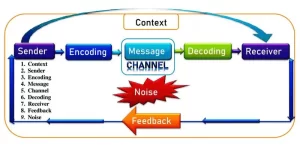
The process of communication is further refined in 6 phases
At phase I, the sender has an idea or information. At phase II, the sender encodes the idea for transmission and at phase III, the encoded idea is transmitted by the sender through the strategically selected channel or medium of transmission.
At phase IV, the receiver gets the message, at phase V, the receiver decodes the message and finally at phase VI, the feedback is sent by the receiver.

Mary Ellen Guffey says that, “we cannot just glance at another person and transfer meaning directly from mind to mind, we engage in a sensitive process of communication that involves five steps”. These steps are depicted in Figure.
The main elements that are also human as the concepts or the components of the process of communication are discussed to draw the basic understanding of the communication process.
Elements of communication process are:


John G. Glover in his book on “Fundamentals of Top Management’ has given the following objectives of communication in an organization:


There are 7 C of effective communication which are relevant to both written as well as oral communication.


The barriers to business communication are anything that interferes in the communication process.


Not a member yet? Register now
Are you a member? Login now