
Public speaking is a talk given to a large gathering. It is given on various occasions. Its aim is usually to encourage, appreciate, congratulate or entertain; it is usually followed by applause from the audience.
The person in responsible positions must be good speakers as there are many occasions when they are called for addressing the audience. Being able to speak well is an asset in any profession. Speaking skill can be cultivated and developed with approximate knowledge of the formal aspects of public speaking, and with practice.
The most significant requirement for public speaking is its preparation. Even persons who have natural skill in speaking need preparation to convey a good speech.
Some of the characteristics of good public speaking or good speech are mentioned below:
(a) Clarity. (b) In the manner of an informal talk. (c) Speech should be Vivid and concrete. (d) Make the speech brief. (e) Speech should be interesting. (f) Audience-Oriented
Clarity is the first main feature of a good speech. Your speech should be successful in conveying to the audience the ideas, emotions, facts or arguments, you want to express.
Top 10 English Verbs for Conversations on Public Speaking and Effective Communication
1. Express: The ability to express oneself clearly is at the core of effective communication. When we express our thoughts, we’re able to convey our message in a way that is easily understood by others. Whether it’s through words, gestures, or even facial expressions, the verb ‘express’ encompasses all these forms of communication.
2. Engage: Communication is a two-way street, and to truly connect with our audience, we need to engage them. This involves capturing their attention, encouraging their participation, and creating a dynamic environment. When we engage our listeners, we’re not just speaking at them, but rather, we’re fostering a dialogue.
3. Persuade: In many instances, our goal is not just to inform, but also to persuade. Whether it’s convincing someone of our viewpoint or inspiring them to take action, the verb ‘persuade’ is key. It involves presenting our arguments in a compelling manner, using evidence, logic, and even emotional appeals.
4. Adapt: Effective communication is not a one-size-fits-all approach. It requires us to adapt to different situations, audiences, and even cultural contexts. The ability to adapt means being flexible in our communication style, using appropriate language, and being sensitive to the needs and expectations of our listeners.
5. Summarize: In conversations, especially those that involve complex topics, the ability to summarize is invaluable. It allows us to condense information, highlighting the key points and ensuring that our message is clear and concise. When we summarize, we’re essentially distilling the essence of what has been said.
6. Facilitate: In group discussions or meetings, our role may not always be that of the speaker. Sometimes, we’re in the position of a facilitator, whose job is to ensure that the conversation flows smoothly. The verb ‘facilitate’ means to make something easier or more accessible, and in the context of communication, it involves guiding the discussion, encouraging participation, and managing any potential conflicts.
7. Clarify: Misunderstandings can easily arise in communication, and to avoid this, we need to clarify. When we clarify, we’re seeking to make something more understandable or to remove any doubts or confusion. This can be done through asking questions, providing examples, or even rephrasing what has been said.
8. Convey At its core, communication is about conveying a message from one person to another. The verb ‘convey’ means to transport or transmit something, and in the context of communication, it involves ensuring that our message is delivered accurately and effectively. This can be done through various means, such as verbal communication, visual aids, or even body language.
9. Collaborate: In many professional settings, effective communication is closely tied to collaboration. The verb ‘collaborate’ means to work together with others towards a common goal. This involves not just sharing information, but also actively listening, considering different perspectives, and finding solutions as a team.
10. Conclude: Every communication has a conclusion, a point where we wrap up our thoughts or reach a decision. The verb ‘conclude’ means to bring something to an end or to reach a final decision or judgment. When we conclude a conversation, we’re essentially providing closure and ensuring that our message has been understood.
Conclusion And there you have it, the top 10 English verbs for conversations on public speaking and effective communication. By incorporating these verbs into your vocabulary, you’ll be well-equipped to navigate various communication scenarios. Remember, communication is not just about the words we use, but also about how we use them. So, keep practicing, keep refining your skills, and you’ll soon become a confident and effective communicator.
The speech should be vivid including in it concrete facts easy to perceive and visualize.
The concentration of an average audience does not last more than twenty or 25 minutes. Hence, an ideal speech should not exceed that time, unless the audience is motivated by certain interesting facts during the speech.
Quotations, anecdotes and humorous touches often make a speech very interesting. The quotations should be familiar and accepted by experts. Anecdotes should be novel, brief and in good taste. Humour should be typical, spontaneous and gentle.
Speeches are hard for most of us. The public speaking techniques can be adopted to improve the public speaking.
Your first step in formal speechmaking is to decide the topic of your presentation.
In some cases, you will be allotted a topic, normally one within your area of specialization. In fact, when you are asked to make a speech on a specified topic, it is probably to be because of your knowledge of the topic.
In your search for a suitable topic, you should be guided by three basic factors.
After you have decided what to talk about, you collect the information you need for your speech.
This step may require searching through your mind for experiences or ideas, final research in a library or in company files, collecting information online, or consulting people in your own company or other companies.
Although variations are sometimes appropriate, you should commonly follow the time-honored order of a speech: introduction, body and conclusion.
The introduction of a speech has much the same goal as the introduction of a written report, to gear up the listeners (or readers) to pick up the message. But it usually has the additional goal of arousing interest.
Unless you can arouse interest at the beginning, your presentation is probable to fail. The techniques of arousing interest are limited only by the imagination.
One possibility is a human-interest story, for storytelling has a strong appeal. Humor, another possibility, is probably the most widely used technique. In addition to arousing interest, your opening should lead to the theme of your speech.
Organizing the body of your speech is much like organizing the body of a report. You take all and divide it into comparable parts. Then you take those parts and divide them. You continue to divide as far as it is practical to do so.
In speeches, nevertheless, you are more likely to use factors rather than time, place, or quantity as the basis of division as in most speeches; your presentation is likely to build around issues and questions that are subtopics of the subject. Even so, time, place, and quantity subdivisions are possibilities.
You need to stress the transitions between the divisions because, unlike the reader who can see them, the listeners may miss them if they are not emphasized adequately. Without clear transitions, you may be talking about one point and your listener may be relating those ideas to your former point.
Like most reports, the speech normally ends by drawing a conclusion. Here you bring all that you have presented to a head and accomplish whatever goal the speech has. You should consider together with these three elements in your close:
Adding the speech to a climactic close—that is, making the conclusion the high point of the speech —is usually effective. Present the concluding message in strong language—in words that gain attention and will be remembered. In addition to concluding with a summary, you can give a suitable quote, use humor, and call for action.
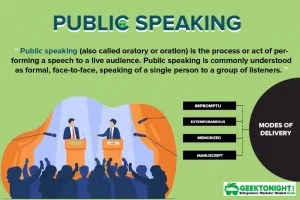
There are four main modes of delivery used in public speaking:
The impromptu speech is delivered with little opportunity to prepare. Its main virtue is that it is spontaneous; its main shortcoming is that it is usually not well planned. When you are urged “say a few words” without any advance warning, what leads is an impromptu speech.
Extemporaneous speaking is somewhat more formal than impromptu speaking. You have an opportunity to plan, and the resulting speech is better organized than an impromptu speech. You will normally rely somewhat on notes, but you will not read to the listeners. Most public speeches are delivered extemporaneously.
A memorized speech allows for a well-planned expression of ideas. When presenting a speech from memory, how, speakers have tendency to lose a certain amount of naturalness and sometimes sound and look quite wooden. The possibility of forgetting the speech is another negative aspect of the memorized speech.
Manuscript speaking is relied on for more formal occasions. Speaking from a manuscript, you are able to be very precise, and you can carefully control the exact message the listeners receive. Naturally, it in general takes longer to develop a manuscript speech, and often the manuscript becomes a barrier between you and the listeners.
The ability to speak effectively depends on some trades and qualities. It is also dependent upon communication situation.
The following is a checklist of features that are often associated with effective public speaking skills.
The best presenters and speakers speak in a usual way that invites you to make some modifications in your life, no matter how small.
Thus, there are three vital purposes of public speaking which are explained below:
Informative speaking is regarded as one of the most common types of public speaking. The main purpose of informative presentations is to share one’s knowledge of a subject with an audience. Reasons for making an informative speech differ broadly.
Example: Let’s say, you might be asked to teach a group of co-workers on how to use new computer software or to report to a group of managers how your latest project is coming along. It is incorporated into various different works.
Therefore, learning how to speak efficiently has become an important skill in today’s scenario.
Another reason for speaking to an audience is to persuade others. In our everyday lives, we are often called on to motivate, convince, or otherwise persuade others to take an action, change their beliefs, or reconsider a decision.
Persuading customers to purchase your firm’s products, advocating for music education in your local school district, or inspiring high school students to attend college all involve affecting other people through public speaking.
Whether public speaking is something you do every day or just a few times a year, convincing others is a challenging job. If you develop the skill to convince successfully, it can be professional as well as personally rewarding.
Entertaining speaking includes an array of speaking occasions ranging from introductions to presenting and accepting awards, wedding toasts, to delivering eulogies at funerals and memorial services in addition to motivational speeches and after-dinner speeches.
As with informative and persuasive speaking, there are professionals, from religious leaders to comedians, who make a living simply from delivering entertaining speeches.
Not a member yet? Register now
Are you a member? Login now