
Downward Communication flows from a top-level to a low level in an organization is known as downward communication. In other words, communication that takes place from superiors to subordinates in a chain of command is a downward communication.
This flow of communication is used by the managers to convey work-related information to the employees at lower levels. Employees require this information for carrying out their jobs and for meeting their manager’s expectations.
It may include efficiently managing the tone of the message, and also showing skill in a delegation to make sure the job is done efficiently by the right person.

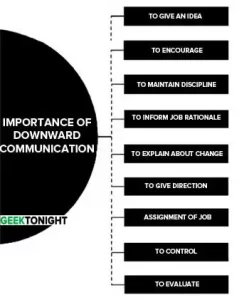
With the help of downward communication objectives, policies, rules are explained to the subordinates by superior to give complete understanding.
Employees are required to be motivated to work more to achieve organisational objectives. Management has to resort to downward communication to encourage lower-level employees.

Such communication follows the organizational hierarchy, so every section unit or department must follow the set rules or procedure. As a result, discipline is ensured.
An important objective of this type of communication is to give information regarding the rationale of the task assigned and its relation to other organizational tasks.
Changes are dependent to circumstances. When there is any change in respect of plans, policies, procedures or rules etc. such are communication with explanation through downward communication.
To direct any assignment, job or task to the subordinates, superior makes downward communication.

To assign job according to efficiency of the workers, superior makes justification through downward communication.
Since necessary instructions are forwarded through downward communication, employees are very much aware about their task and activities. Therefore, such communication can act as a control tool.
Downward communication helps supervisors to evaluate works performed by the employees. Downward communication is used to inform the employees of their evaluations.

The advantages of downward communication are as follows:
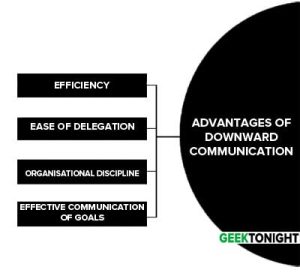
Downward communication offers efficiencies because instructions and information come from the sources in power that are able to coordinate activities from the top of the organization.
Delegation is much easier if the delegation comes directly from the vertical communication structure representing the chain of command.

Downward communication follows the organization’s hierarchy, meaning that organizational discipline and member compliance is much easier to maintain.
Upper management can easily communicate goals and assign responsibilities regarding achieving those goals.

The disadvantages of downward communication are as follows:
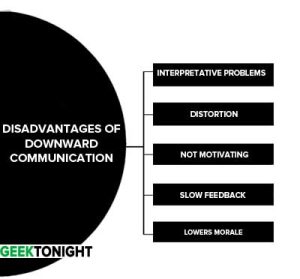
Downward Communication presents interpretation problems because of the distortion effect and the slow feedback for message clarification.
Ever played the grapevine game? Downward communications can become distorted as it proceeds through multiple levels of the organization.

Given slow feedback and the dependence on formal channels of communication, this method of communication doesn’t really help with motivation.
It takes time for messages to go down the organization and then up the organization and then back down again. This means that feedback can be slow, resulting in problems, especially in a dynamic environment.
Given the time communication takes and the problem with distorted messages, downward communications can have a negative impact on organizational morale.

Canary (2011) has identified five general purposes od downward communication:
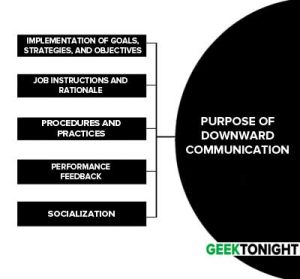
Communicating new strategies and goals provides information about specific targets and expected behaviors. It gives direction for lower levels of the school/school district, community college, or university.
For example: “The new reform mandate is for real. We must improve the quality of student learning if we are to succeed.”

These are directives on how to do a specific task and how the job relates to other activities of the school organization. Schools, community colleges, or universities need to coordinate individual and departmental objectives with organization-wide goals.
We often fail to provide enough of this kind of information, leaving it to the individual staff member to get the big picture.

These are messages defining the school organization’s policies, rules, regulations, benefits, and structural arrangements in order to get some degree of uniformity in organization practices.
In school organizations, this information is transmitted to staff members through board and organization-wide policy manuals, handbooks, and the day-to-day operation of the school organization.
Departmental progress reports, individual performance appraisals, and other means are used to tell departments or individuals how well they are doing with respect to performance standards and goals.
For example: “Mary, your work on the computer terminal has greatly improved the efficiency of our department.”

Every school organization tries to motivate staff members to adopt the institution’s mission and cultural values and to participate in special ceremonies, such as picnics and United Way campaigns. It is an attempt to get a commitment, a sense of belonging, and a unity of direction among staff members (Lunenburg & Ornstein, 2008).
For example: “The school thinks of its employees as family and would like to invite everyone to attend the annual picnic and fair on May 30.”
Communication which flows to a higher level in a company is known as upward communication. It gives feedback on how well the company is working.
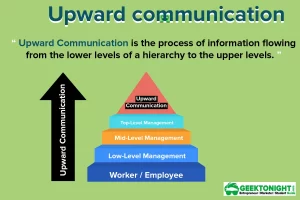
The subordinates use upward communication to express their performances and problems to their superiors. The subordinates also use upward communication to tell how well they have understood the downward communication. It can also be used by the employees to share their ideas and opinions and also to take part in the process of decision-making.
Some of the upward communication definition are:

The advantages of upward communication are as follows:
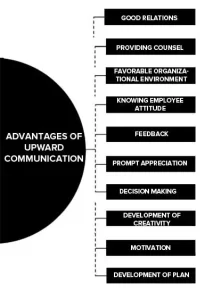
Subordinates express their opinions in terms of upward communication. As a result, the harmonious relationship prevails between the superiors and subordinates.
Subordinates can provide their constructive opinions to the superiors through upward communication. These opinions may be useful to the achievement of organisational goals.

Upward communication enriches the relationship between subordinates and superiors. As a result organisation attains continuous development.
Every organisation starts some welfare measures for the employees. If upward communication is active then management can know that how far employees are satisfied with the welfare activities.
Through such communication, the subordinates send back their reactions to the decision sent by the superiors. Thus upper-level management can ensure whether the lower-level employees have accepted the message sent by the superiors.

Because of upward communication, subordinates get the opportunity to praise their boss for any positive or effective movement. This ultimately results in a cordial relationship between superiors and subordinates.
Upper management wants to know specific information regarding production, procurement, marketing, financial matters and so on before making any decision. Subordinates supply the related information through upward communication and thus decision making is made easier and quicker.
Upward communication calls for a creative environment to grow where employees show their initiatives for development.

Upward communication allows the lower-level staff to express their attitude or opinion to upper-level staff. As result subordinates are influenced to work more towards fulfilment to target.
Upper-level management can collect information from lower-level management through upward communication. Information obtained from such communication can be used to develop and implement any plan.
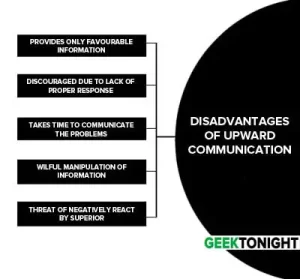
There are many problems that you can see in upward communication.
Horizontal communication takes place between two or more persons who are working at the same levels.
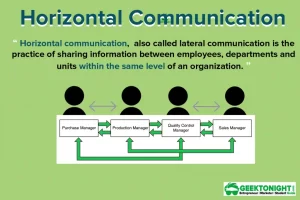
Horizontal communication is the flow of information across departmental boundaries, either laterally or diagonally.
It is a communication among people at the parallel or same level, position, rank or statues people of the organization.
Horizontal communication is the communication that flows laterally within the organization, involves persons at the same level of the organization. Horizontal communication normally involves coordinating information and allows people with the same or similar rank in an organization to cooperate or collaborate.

Defination: Horizontal communication relates to messages communicated among people on a similar level of the hierarchy.
Horizontal Communication Example, in terms of the workplace, if two board members raise an issue or if two supervisors have a discussion then this is termed as horizontal communication.
Horizontal communication generally involves coordinating information and permits people with the same rank in an organization to collaborate or cooperate.
The Figure below shows the Horizontal Flow of Communication where messages or information flows among the similar or same level positions of people in the organizational structure.
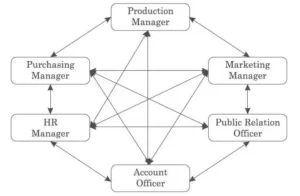
Following are the essentials of effective horizontal communication:
To make the communication system more effective a manager should persuade the employees by supervising.
To ensure effective communication, departments must be developed in a way that they act as lubricants in the process of effective horizontal communication.

To make horizontal communication effective top executives must recognize it is a useful and realistic means to exchange a message.
Care should be taken that managers have a clear understanding that horizontal communication is a functional part of the total process of communication.
To make it effective this communication system should be considered a form of emergency communication to affect a quick resolution to a particular problem.
To make it effective, organisational structure should be made in such a manner that the opportunity for inter-departmental communication can be confirmed.

Discipline should be maintained strictly at each level so as to maintain effective communication, otherwise management experience gaps in the working atmosphere.
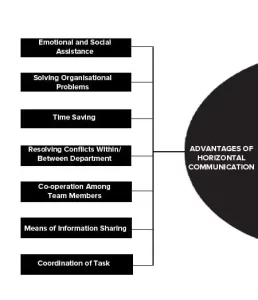
The advantages of horizontal communication are as follows:

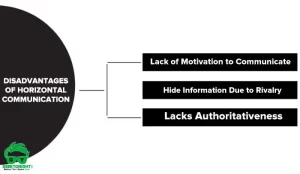
The major disadvantage of horizontal communication is that as the responsibility is spread out over team members and project leaders, there is very little real authority.
This can result in a loss of control, which can slow productivity when things go wrong. It can be very problematic to change from a vertical to a horizontal structure.
Not a member yet? Register now
Are you a member? Login now