
Organizational communication is the process by which individuals induce meaning in the minds of other individuals, by means of verbal and nonverbal messages in the circumstance of a formal organisation.
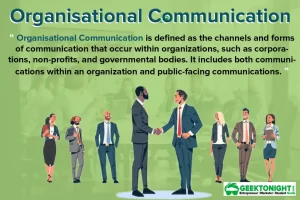
Organisation communication is defined as “a program that focuses on general communication processes and dynamics within organisations.
Includes,
Following are the reasons for the importance of organisational communication:
Organizational communication takes place upward, downward and horizontally.
In the book “Organizational Communication: Challenges of Change, Diversity, and Continuity,” William Neher identifies the Five primary functions of business communication as:
The function of leading is important to enabling management to issue instructions in a clear, specific manner so that workers are able to follow them without difficulty. This is generally downward communication.
This function enables management to explain the reasons for instructions in a way that workers can understand. In this context, it is downward communication; however, rationalizing is also important for enabling workers to bring issues to the attention of management, using upward communication to do so.
If a worker identifies a motivation problem, for example, he may communicate this upward formally to management and use rationalization to highlight the potential impact of the problem on profitability.
Most companies hold regular meetings to discuss issues such as production cycles, delivery times, price margins and other areas where unusual situations could arise that may affect the performance of a business.
In these meetings, organisational communication plays an important role in tabling problems, brainstorming potential responses and finalizing solutions. In this way, a company obtains maximum benefit from the abilities of those involved in the communication, which flows horizontally and often informally.
Conflict in the workplace can lead to the loss of talented employees, the lodging of grievances and possibly lawsuits. Managing conflict by bringing all parties together to discuss their differences in a safe, moderated environment is an important function of organisational communications.
This type of communication usually involves all three directions of communication, and, although discussions may be informal, the final decisions are usually communicated formally.
Gaining compliance of employees is necessary for them to adhere fully to instructions. To do this, management needs to listen to feedback from the staff and to take account of their ideas and comments.
Feedback or two-way communication can be both upward and downward or horizontal and may be formal or informal, but it is important for a company to enable open communication channels to motivate and achieve the best performance from employees.
Not a member yet? Register now
Are you a member? Login now