
At informal meals, place the napkin in your lap immediately upon seating. During formal occasions, before unfolding the napkin, wait for the hostess to remove her napkin from the table and unfold it in her lap.
How do you hold a fork?
The continental style prevails at all meals, formal and informal, because it is a natural, non-disruptive way to eat.
In most situations, following the inside in rule will tell you which knife, fork, or spoon to use at the dinner table.


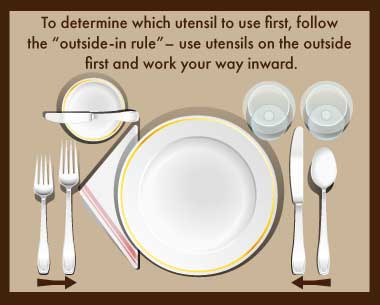
Deciding which knife, fork, or spoon to use is made easier by the outside-in rule – use utensils on the outside first and working your way inward. So, if you are served a salad first, use the fork set to the far left of your plate.
The lower edges of the utensils should be aligned with the bottom rim of the plate, about one (1) inch up from the edge of the table.
To avoid hiding a utensil under the rim of a plate or bowl, lay it approximately one (1) inch away from the plate’s side.
To eliminate fingerprints on the handle, hold flatware by the “waist,” the area between the handle and the eating end of the utensil.
Elbow room requires a minimum of 15 inches between place settings, or approximately 24 inches from the center of one place setting to the middle of the next.
Butter should be waiting on butter plates, the glasses filled with water, and the wine ready to be served before the guests are seated.
The water glass should be placed approximately one (1) inch from the tip of the dinner knife.
Place knives with blades facing the plate.
Do not place over three pieces of flatware on either side of the plate at one time (except forks if an oyster fork is used).
When an uneven number of people are seated, the odd-numbered place settings are laid opposite the middle of the even-numbered place settings.
Try to plan the table setting to match your menu. When bread and butter are served, add a butter plate to the table. Use separate salad plates if serving your main course with gravy.
Depending upon the occasion, you may want to use a “formal” or an “informal” table setting. Most of us will infrequently use a formal setting.
Tablecloths and Placemats
Although a formal dinner requires a tablecloth, at informal dinners a tablecloth is optional. A bare table with place mats is the alternative.
Dinnerware, Flatware, Glassware
If you don’t have enough good china and flatware to create place settings for your guests, you have three alternatives.
Centre pieces and candles
Flowers or Bowls of fruit work well as a centerpiece. Make sure the centerpiece doesn’t stand so tall that guests can’t see over it.
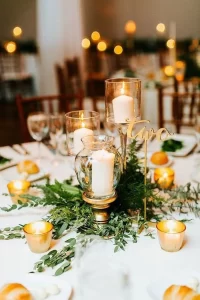
Candles, if meant to be merely ornamental, are placed on either side of the centerpiece. Or, place one candle above each place setting if they will be used as the only source of light.
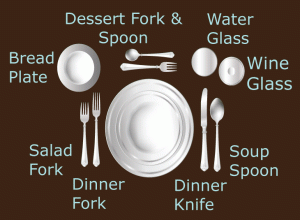
At an informal meal, all flatware is laid on the table at one time. At the host’s option the dessert utensils may be brought to the table on the dessert plate.
The following is a standard table setting for a three-course meal. Note the basic “outside-in” rule. The piece of flatware that will be used last is placed directly next to the plate you are using.
Both forks are placed on the left of the plate. The fork furthest from the plate is for salad. The fork next to the plate is for the dinner. (Please Note: At more formal where the salad is served after the main course, the order of placement is reversed.)
Fork tines may be placed downward, in the continental style, or upward, in the American style.
The dinner plate is placed on the table when the main course is served and is not on the table when the guests sit down.
The salad plate is placed to the left of the forks.
Small plates, such as the salad plate, fish plate, and dessert plate , are laid about two (2) inches in from the edge of the table.
The dinner knife is placed on the right side, and directly next to and one (1) inch away from, the plate. The blade should face the plate. If the main course requires a steak knife, it may be substituted for the dinner knife.
Spoons
A small bread plate is placed above the forks, above and to the left of the service plate.
The butter spreader is laid on the bread-and-butter plate.
Usually, one wine glass is used along with a water goblet. If the table setting is uncrowded, there is room to arrange glassware in any way you like, such as in a straight line parallel with the edge of the table or a diagonal line angled toward the table’s edge.
The water glass is placed in a position closest to the hand, approximately 1 inch above the tip of the dinner knife.
At least one wine glass should sit to the right and possibly above the water glass.
Place the napkin in the place setting’s center, or left of the last fork.
Place a cup and saucer to the right of the place setting. The coffee spoon goes to the right of the saucer.
Place approximately one (1) inch beyond the outermost piece of flatware. The top edge of the saucer is aligned with the top rim of the plate or bowl.
Cup handles are faced in the four o’clock position for easy access.
At an informal meal, when two utensils are provided for dessert, the utensils are laid on the table or presented on the dessert plate.
The dessert spoon (or dessert knife) is laid on the table above the dinner plate in a horizontal position, handle facing right.
The dessert fork is laid beneath the dessert spoon (or dessert knife), handle facing left.
The dessert utensils may also be presented on the dessert plate in the same way as formal service.
Since more people use salt than pepper (and most people are right-handed), the saltshaker is placed to the right of the pepper shaker, in a position closer to the right hand.
The placement of the pepper shaker is to the left of the saltshaker, and for added definition it is angled slightly above the saltshaker.
They are placed above the cover or between two place settings.
Because salt is finer than pepper, the lid of the saltshaker is punctured with smaller, more numerous holes than a pepper shaker.
To avoid clutter, the general rule for a any table setting is to include no more than three utensils on either side of the dinner plate at a time. The exception is the oyster (or seafood) fork, which may be placed to the right of the last spoon even when it is the fourth utensil to the right of the plate. The initial table setting for a typical formal dinner should look something like this:
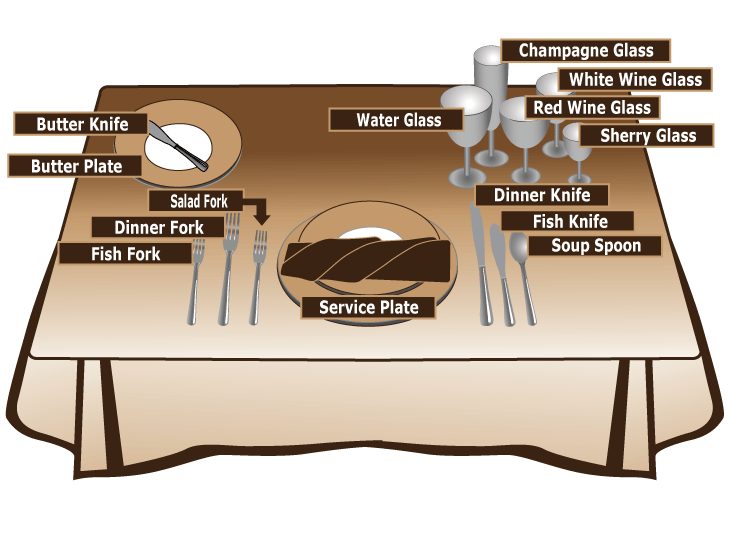
Service Plate: Place the service plate in the center of the place setting.
Butter Plate: A small bread plate is placed above the forks, above and to the left of the service plate.
Glasses
Forks
Knives
Spoons
Oyster Fork: If present, on the right of the soup (or fruit) spoon.
Dessert Spoons And Forks
Salt and Pepper.
Finger Bowls.

Serve something you’ve served before. Have a simple to prepare fallback if something goes wrong with a dish or course.
INFORMAL DINNER PARTY
The Menu
Consider the season.
Light foods, such as main-course salads and cold soups, are good choices in the summer.
Heavy foods, such as stews and roasts, in winter.
Make use of the season in another way by creating a menu using fresh seasonal foods.
Consider the limitations of your kitchen.
One oven. If you have only one oven and plan to cook a roast, don’t also plan dishes that must be cooked in the oven at the same time but under different temperatures. Instead, prepare a salad, saute squash, steam vegetables, or mash potatoes on the stove.
Limited space. Prepare dishes ahead of time and carefully plan your cooking times.
When pre-dinner drinks or cocktails are served,
Two or three varieties of cocktails should be offered:
Guests should be given enough time to have a couple cocktails.
You may serve light snacks or hors d”oeuvres with drinks. They should have compatible flavors with the food to be served at dinner.
Late Guests
Delay dinner fifteen (15) minutes for a late guest. When the guest arrives, he or she is served the course that is being served at the time.
SERVING DINNNER
When dinner is ready to be served :
The guest of honor seated on the host’s right is always served each dish first. If there is serving help, servers move around the table counter-clockwise from her, serving the host last.
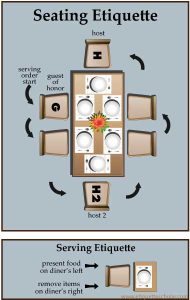
Each dish is supplied with whatever silver is needed for serving it. A serving spoon and a large fork are put on most dishes, or the spoon alone is used if the dish is not hard to serve. With the spoon underneath, the fork is held with the prongs turned down to hold and balance the portion when both utensils are used.
At a more casual dinner party,
Since any of these procedures can take time, the host or hostess should insist that guests start eating after three or four people have been served.
Except at formal dinners, bread and other condiments are usually passed around the table by the guests themselves.
Dishes are passed counter-clockwise to the right and should be passed in the same direction.
A guest helps himself to the breadbasket with his fingers and lays the roll or bread on his butter plate.
If there is a choice of two or three sauces or other condiments, placing them together in a divided dish, or on a small, easily managed tray, ensures that they are passed together.
If you have a sideboard or serving table, use it as a halfway station between the dinner table and the kitchen. On it you can have plates for the next course and extra flatware.
Serving dishes, after being passed, can be left on the serving table on a warming tray or taken to the kitchen and kept warm on the stove.
When you see that guests are ready for another portion, get up, get the serving bowl and pass it around.
Dessert may be served already placed on individual dessert plates, or the hostess may serve it at the table.
When the table is cleared, dishes are removed two at a time, never stacked. Salt-and-pepper containers and condiment dishes are cleared also.
Salad plates as well as the plates used for the entree are removed before dessert is served.
To accelerate the clearing process, bring back dessert plates, or whatever is needed for the next course, when you return from the kitchen. Or have a friend serve the dessert while you finish clearing.
Any salt-and-pepper shakers, unused flat silver, and dishes of nuts are taken off (on a serving tray, if you like).
To guests who offer to help you clear, just say, “No, thank you, really it is easier to do it myself”-or you may find that everyone is suddenly on his or her feet and in the kitchen. It’s better to designate a serving and cleaning buddy in advance to help.
After-dinner coffee may be served either at the dining table or in another room to which the diners have moved.
The hostess pours the coffee right at the dining-room table or from a tray that has been carried to the living room or den.
If coffee is served at the table, bottles of after-dinner drinks may also be placed on the table.
If coffee is served in the living room, a tray containing bottles and glasses is placed on the coffee table.
Not a member yet? Register now
Are you a member? Login now